Introduction
Every photo you upload, every message you post, every memory you share online feels permanent, until it isn’t.
Social media has become the default place where people store their lives. Birthdays, relationships, milestones, even grief, are uploaded into feeds designed for speed, visibility, and constant updates. But what actually happens to those memories over time?
As platforms change, algorithms shift, and accounts disappear, many people are starting to ask a bigger question:
Are social media platforms really built to preserve memories?
This is where the idea of digital time capsules begins to matter.
How Social Media Treats Your Memories
Social platforms are designed for engagement, not preservation.
Once a post leaves the spotlight:
- It’s buried by newer content
- Resurfaced only when an algorithm decides
- Rarely revisited intentionally
Even meaningful moments, weddings, childhood photos, and personal reflections become fragments scattered across timelines, stories, and archived posts.
Over time:
- Accounts are forgotten
- Platforms shut down or change ownership
- Content policies evolve
- Access can be lost entirely
Social media doesn’t protect memories; it consumes them.
The Problem With Algorithm-Based Memory Storage
Algorithms decide:
- What you see
- When you see it
- Whether you see it at all
That means your most important moments are:
- Mixed with ads
- Surrounded by noise
- Reduced to engagement metrics
Memories become content, not something intentional, private, or meaningful.
This is why many people feel disconnected from their own digital past, even though they’ve “saved everything”.
What Is a Digital Time Capsule?
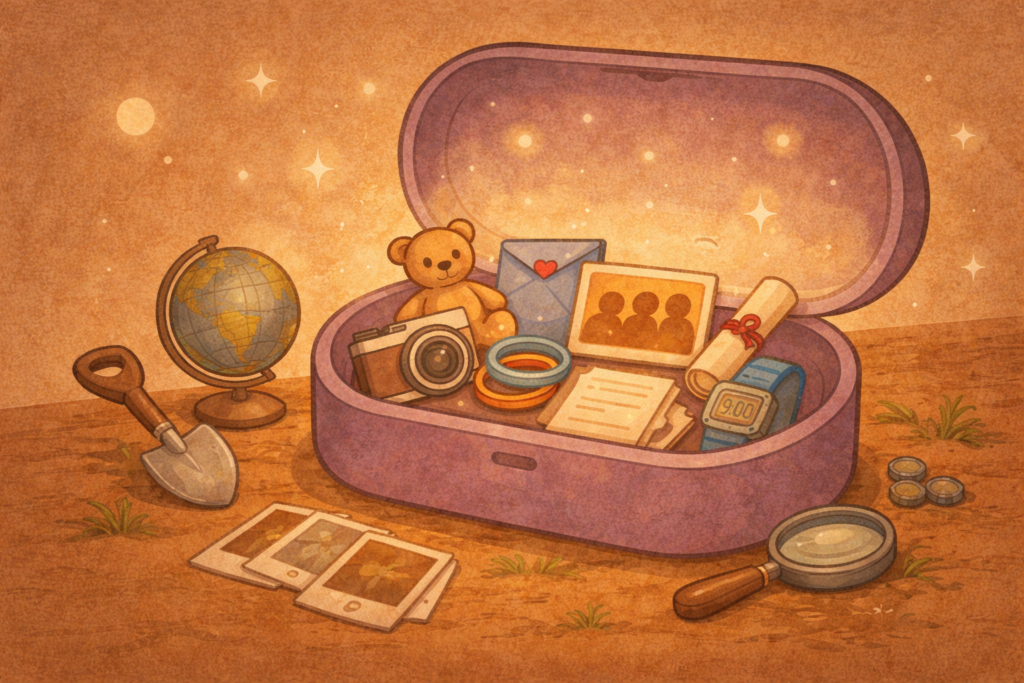
A digital time capsule is a private, intentional way to store memories online and unlock them at a chosen time in the future.
Unlike social media, digital time capsules are designed for:
- Long-term memory preservation
- Privacy-first storage
- Emotional significance
- Personal or shared milestones
Instead of posting memories publicly, you lock them away to be opened months, years, or even decades later.
Photos, videos, messages, and voice notes aren’t buried in a feed. They wait, untouched, until the right moment.
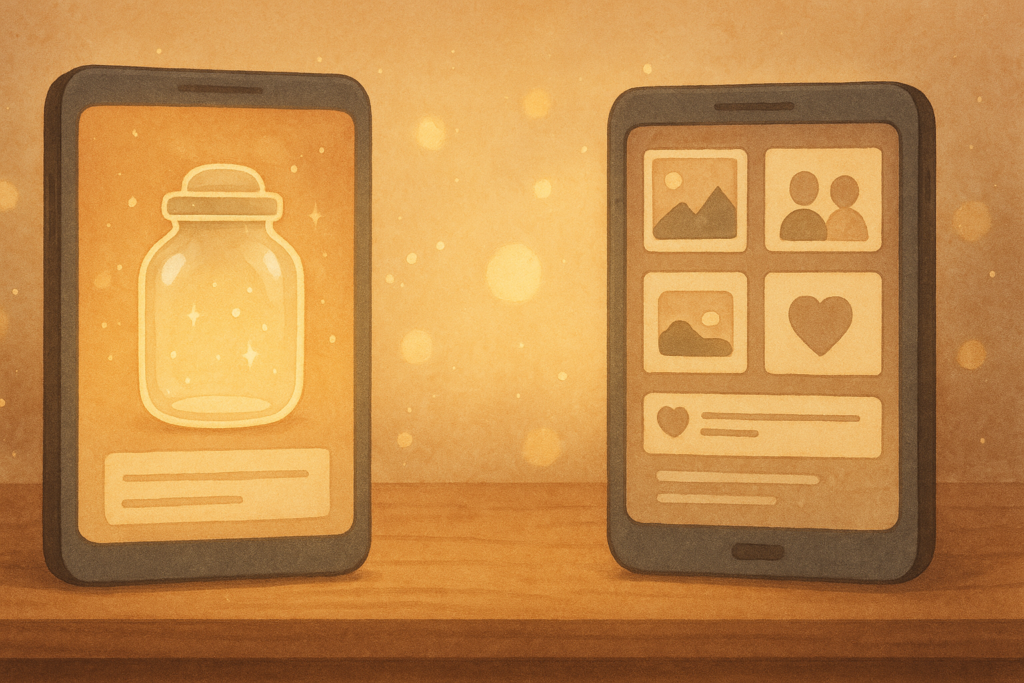
Digital Time Capsules vs Social Media: Key Differences
Purpose
- Social media: Visibility and engagement
- Digital time capsules: Preservation and meaning
Control
- Social media: Platform-owned, algorithm-driven
- Digital time capsules: User-controlled, time-based access
Privacy
- Social media: Public or semi-public by default
- Digital time capsules: Private, permission-based
Longevity
- Social media: Tied to platform survival
- Digital time capsules: Built for long-term access
Why Intentional Memory Keeping Matters
Memories gain meaning through context and timing.
Opening a message from your past self. Revisiting a moment you intentionally saved for the future. Sharing a memory with someone only when the time feels right.
This level of intention is impossible on traditional social platforms.
Digital time capsules restore:
- Emotional weight
- Narrative continuity
- Ownership over personal history
They turn memory keeping from passive scrolling into an active choice.
The Rise of Privacy-First Digital Memories
As people become more aware of:
- Data ownership
- Platform risk
- Digital legacy
There’s a growing shift toward privacy-first memory storage.
Instead of trusting third-party platforms built for advertising, users are seeking tools designed specifically to protect personal moments, not monetise them.
Digital time capsules fit naturally into this shift.
Where TimeLock Fits In
TimeLock is being built as a next-generation digital time capsule platform, focused on secure memory preservation and long-term access.
The current Web 2.0 MVP allows users to:
- Create personal and collaborative digital time capsules
- Store memories securely online
- Lock content until a chosen future date
Looking ahead, TimeLock is evolving toward a hybrid Web 2.0 and Web 3.0 architecture, exploring advanced encryption, long-term data integrity, and ownership-driven memory preservation.
The goal isn’t to replace social media; it’s to give memories a place where they aren’t rushed, ranked, or forgotten.
The Future of Digital Memories
Social media will always exist. But not every memory belongs in a feed.
As digital lives grow larger, the need for structured, secure, and intentional memory preservation becomes unavoidable.
Digital time capsules aren’t a trend; they’re a response to how fragile modern memory storage has become.
The question isn’t whether people will need them. It’s when they realise they already do.
Final Thoughts
If social media is where memories are shared, digital time capsules are where memories are kept.
One is built for attention and the other is built for time.
And in the long run, time is what memories need most.
Related Blog Posts to Explore
- How Time Lock Is Changing the Way We Remember
- The Rise of MemoryTech: Apps That Preserve Your Life
- Digital Capsules for Long-Distance Relationships
- AI vs Memory: Will Technology Ever Replace Sentiment?
Join us on the mission.
LinkedIn | Instagram | Pinterest
Related read: why Gen Z is ditching social for private memory apps.