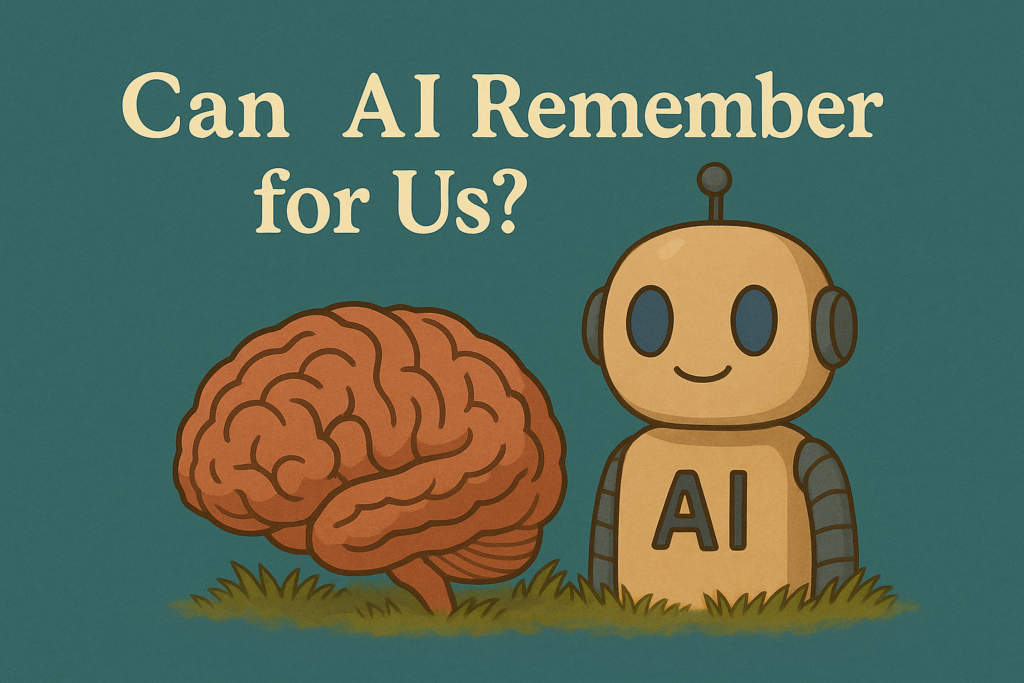
Can AI Remember for Us?
As we increasingly rely on technology to help us organise our lives, a new question emerges: can AI actually remember for us?
Not just in a “set a reminder” kind of way, but in a deeper, more emotional sense. Can AI help us preserve the moments that matter? Can it become a partner in how we archive our lives?
This post explores the rise of AI-powered memory keeping and what it means for our personal histories.
The Rise of Digital Memory
Once upon a time, our memories lived in photo albums, diaries, and dusty boxes under the bed. Today, they live in:
- Cloud drives
- Camera rolls
- Archived messages
- Social media feeds
While that’s convenient, it’s also chaotic. We’re creating more memories than we can manage, millions of photos, voice notes, videos, texts, and we rarely revisit most of them.
This digital overload is where AI steps in.
What Is AI Memory Keeping?
AI memory keeping refers to using artificial intelligence to:
- Sort and organise digital memories
- Tag emotional highlights
- Summarise long videos or conversations
- Suggest meaningful moments to revisit
- Generate timelines or memory maps
Think of it as having a digital memory assistant that filters, organises, and protects what matters most, without you lifting a finger.
AI That Learns Your Memory Style
Not all memories are created equal. Some people value photos. Others save voice notes. Some like raw footage, others prefer neatly edited videos with music and text.
AI can now detect your preferences by:
- Analysing what you save, delete, or revisit
- Learning your tone, writing style, and emotional cues
- Suggesting memory formats based on your habits
It’s not about replacing human memory, it’s about complementing it.
Benefits of AI-Powered Memory Keeping
AI memory tools unlock powerful benefits:
- Efficiency: No more digging through 40,000 camera roll photos.
- Emotionally tuned: AI can highlight smiles, laughter, or keywords that matter.
- Contextual tagging: “This was your birthday” or “First trip with Mum” based on data.
- Automatic archiving: AI can help you lock away moments for future you, or your family.
These tools can also nudge you to reflect on your past with monthly or yearly memory summaries.
The Emotional Side of AI Memory
One might assume AI lacks emotional depth. But it’s becoming surprisingly good at recognising:
- Voice tone
- Facial expressions
- Emotional keywords
- Patterns of significance
Tools like TimeLock take it further by allowing you to embed memories with intent: “Open this on your anniversary,” or “This is for your future child.”
With AI’s help, you can build memory capsules that feel human, thoughtful, and deeply personal.
How TimeLock Uses AI for Memory Curation
At TimeLock, we’re exploring how AI can make memory keeping:
- More intentional (prompting you to reflect and preserve meaningfully)
- Less overwhelming (by organising and tagging memories for you)
- More interactive (with future possibilities of re-living moments through AI playback)
In future versions, we’re looking into AI-generated letters, emotion-based search (“find my happiest moments”), and timeline creation based on your uploaded memories.
Risks and Ethical Considerations
With AI, there are important questions to ask:
- Who controls your memories?
- How is your data used and stored?
- Can AI misinterpret what matters to you?
That’s why any memory-keeping AI needs to be transparent, secure, and user-controlled. You should decide what’s saved, what’s forgotten, and who gets to access it.
Tools like TimeLock are designed with privacy and purpose at the core—memories stay yours, always.
The Future: A Digital Second Brain?
The dream isn’t just to store data, it’s to build a “second brain” that remembers for us:
- What we loved
- What we learned
- Who we were becoming
In that future, AI won’t just store your memories—it will help you make sense of them.
It may even be able to:
- Detect your life patterns
- Suggest what to revisit based on your emotional health
- Help you pass down a curated life archive to the next generation
Start Curating Today
You don’t need advanced AI to begin preserving meaning. What matters is intention.
Start with:
- A letter to your future self
- A voice note of your child’s laugh
- A photo from a moment you don’t want to forget
Then lock it away with Time Lock, so your memories aren’t just stored, but preserved.
Because in a world where AI can remember everything, the only thing more powerful is deciding what’s worth remembering.
Related Blog Posts to Explore
- Time Capsules vs. Cloud Storage: What’s the Real Difference?
- The Rise of MemoryTech: Apps That Preserve Your Life
- Top 5 Apps for Preserving Digital Memories in 2025
- Best Inspirational Quotes to Revisit in 5 Years
Join us on the mission.